
Chihuahua’s manufacturing workforce faces a skills gap as AI and automation reach plant floors
Chihuahua accounted for 25.1% of the value of exports by Mexican states in the second quarter of 2026, and in December 2025 it held 12.3% of the country’s personnel employed in IMMEX program establishments, according to INEGI. In an analysis of the state’s industrial workforce, a professor at the Universidad Autónoma de Chihuahua argues that the next stage of manufacturing will depend less on location or tax incentives and more on whether workers can operate, question and verify automated and AI-based systems.
Companies in Mexico expect AI to transform operations by 2030
The World Economic Forum’s Future of Jobs Report 2025 found that 95% of companies operating in Mexico expect artificial intelligence tools to transform their operations by 2030, 82% plan to accelerate task automation and 63% anticipate greater use of robotics. The state is already present in that conversation: in April 2026, a Chihuahua delegation took part in Hannover Messe forums on industrial AI, advanced automation and digitalization, and in September Chihuahua city hosted the Automotive & Aerospace Nearshoring Summit 2026, with more than 150 exhibiting companies, around 1,000 aerospace executives and more than 2,000 scheduled business meetings.
Plant roles shift in content before they disappear
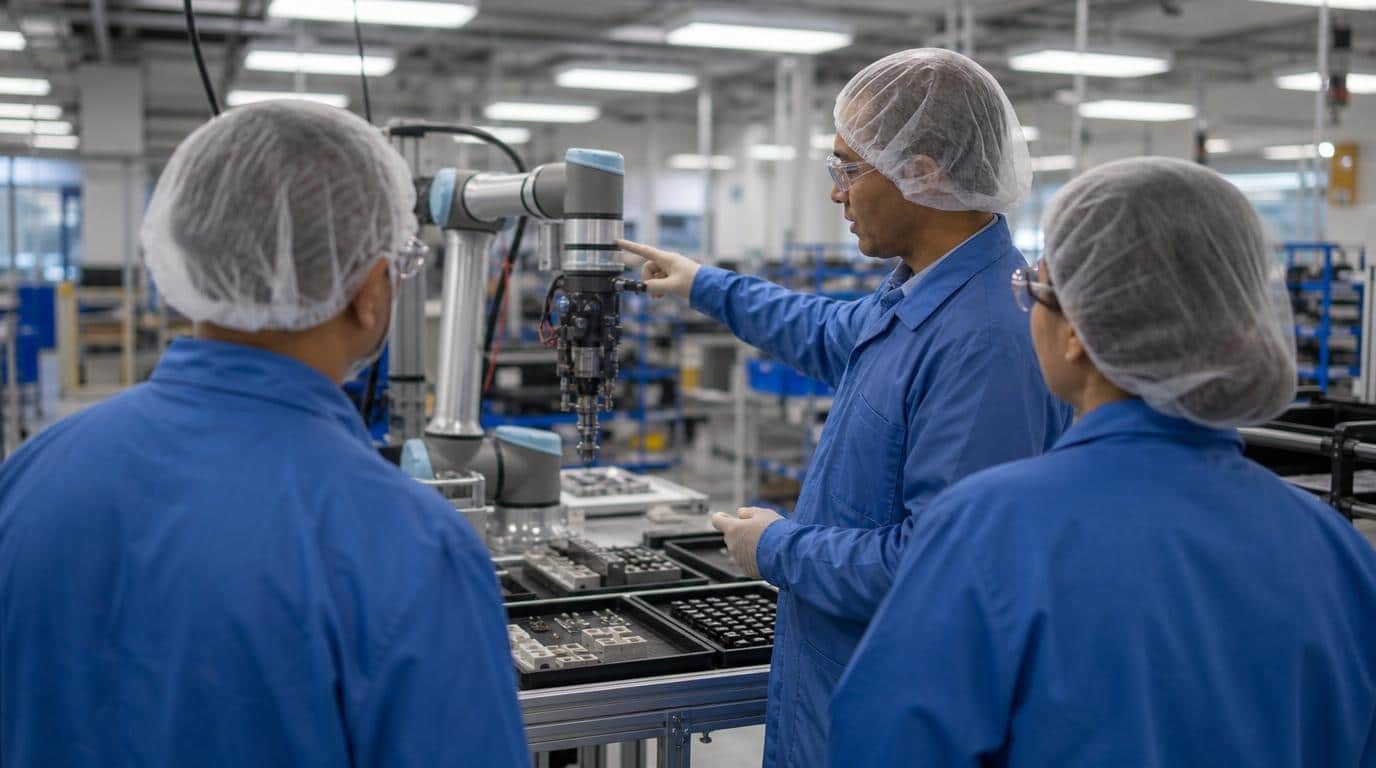
The author describes how jobs on the plant floor change with automation: a technician moves from walking the plant looking for visible failures to interpreting predictive maintenance alerts, a quality inspector moves from checking parts one by one to supervising a machine vision system, and a process engineer spends less time on reports and more on validating models and resolving exceptions. The condition, the author notes, is that workers learn new skills before the old task stops being valuable. An operator who does not understand the process behind an algorithm’s recommended adjustment cannot detect when the algorithm is wrong, which in advanced manufacturing can stop a line, damage equipment or compromise safety.
The column calls on companies to invest in training those already working in the plant before replacing them, alongside shared labs, early internships and microcredentials. An operator with fifteen years of hands-on experience on a line holds tacit knowledge that neither a new graduate nor an AI model acquires in a week, the author writes.
Basic math and reading scores mark the starting point
According to the OECD’s PISA 2022 results, 34% of 15-year-old students in Mexico reached at least the basic proficiency level in math, 53% in reading and 49% in science, compared with OECD averages of 69%, 74% and 76%. The author presents these figures as a measure of the starting point for industrial AI adoption, not as blame on students or teachers.
Chihuahua institutions have added AI and smart manufacturing training
CONALEP added a Data Science and Artificial Intelligence program at its Chihuahua II campus, and the Universidad Tecnológica de Chihuahua integrated AI and data science fundamentals and opened a master’s degree in Smart Manufacturing. CENALTEC opened an Engineering and Design Center with 23 stations and software used by the automotive, aerospace and metalworking sectors, and a second group of students traveled to Taiwan to specialize in smart manufacturing automation. SEECH trained 1,880 teachers from 436 schools in digital tools during the 2025-2026 school year, and the state Ministry of Education (Secretaría de Educación) held a forum on the educational use of AI in October and trained close to 500 special education teachers in November. The author argues the next step is scale and coordination among education, industry and government.
